Four essays in, we've established what we think is broken about Indian EV infrastructure. Metro public CPOs are structurally loss-making. Capital allocation is geographically misaligned. Three of the forty funded companies are profitable. The utilization gap is not closing on the timelines the sector narrative assumes.
This essay is different. It is not about what's broken. It is about what's missing.
We've spent six weeks talking to operators, reading filings, building unit-economic models, and walking fleet depots in Coimbatore and Surat. In that process, seven white spaces have emerged consistently — gaps where the demand exists, the commercial logic is sound, and nobody has yet built the right product. These are the categories where we'd expect the next generation of durable Indian EV businesses to emerge.
White Space 1: Fleet depot operating software
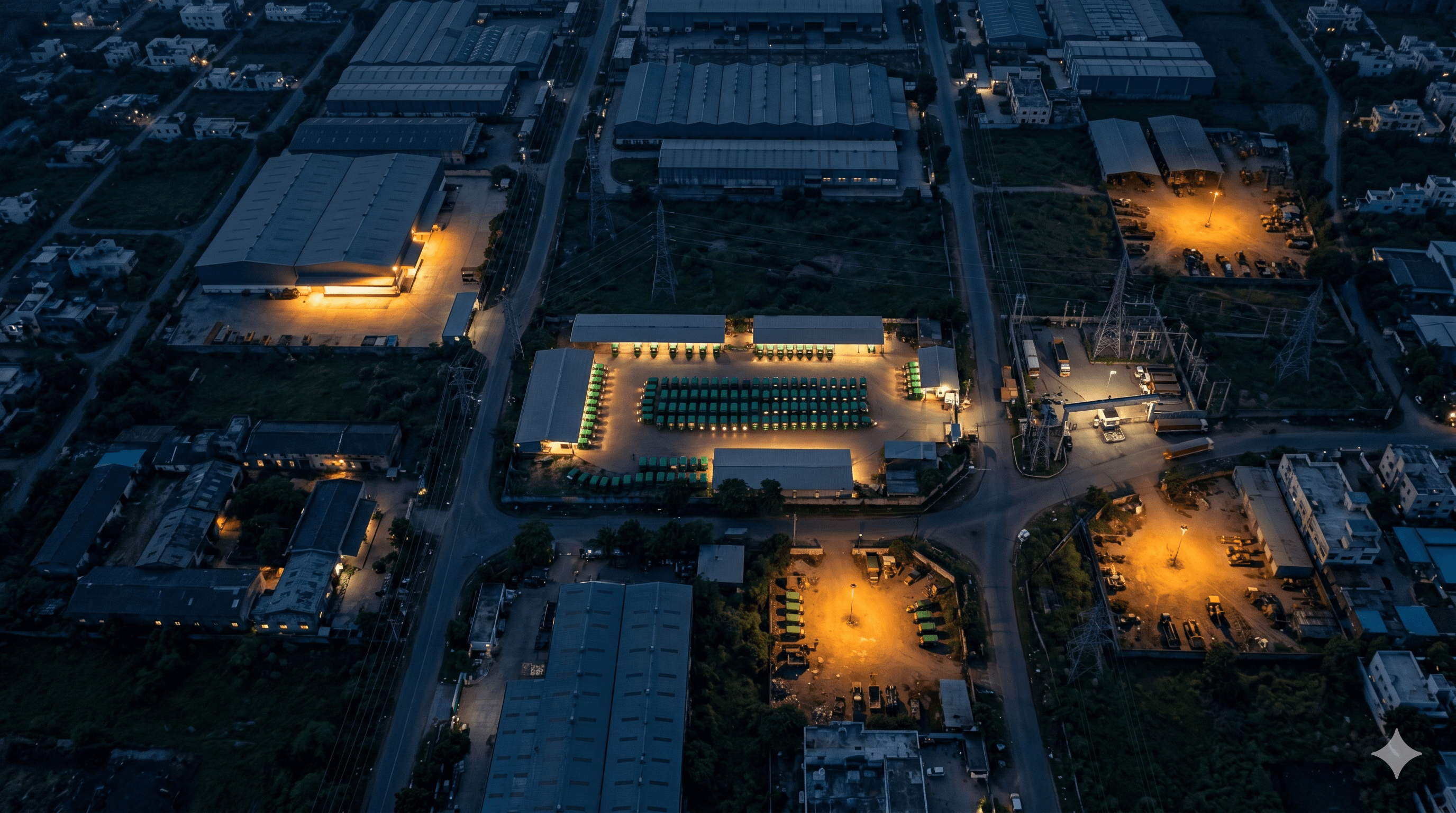
India's Tier 2 fleet depot ecosystem is operationally flying blind. A 60-vehicle 3-wheeler fleet in Coimbatore running its own depot charging infrastructure is tracking vehicle assignments, charging schedules, driver payouts, maintenance intervals, and energy consumption across a combination of WhatsApp groups, Excel sheets, and physical logbooks.
There is no Indian software product purpose-built for this operator. The enterprise fleet management software that exists — largely imported or from large logistics SaaS vendors — is priced and designed for 500-vehicle metro fleets with dedicated IT teams. It doesn't fit.
The white space: a depot operating system priced at ₹2,000–8,000 per month for a 20–150 vehicle captive EV fleet. Core features — charging schedule optimisation, energy cost per vehicle per day, driver assignment, maintenance alerts, DISCOM billing reconciliation. The customer has strong willingness to pay because they're already spending on fragmented tooling that doesn't talk to each other. The churn risk is low because the switching cost is high once the data is in. This is a ₹1 Cr cheque opportunity.
White Space 2: DISCOM tariff navigation as a managed service
Getting a favourable industrial tariff from a DISCOM for a fleet depot or commercial charging site is one of the most underrated operational advantages in Indian EV infrastructure — and one of the most structurally opaque processes a founder or operator faces.
DISCOM tariff structures vary dramatically by state, by distribution zone within a state, and by the category of connection being sought. The process for reclassifying a connection, negotiating a Time-of-Day rate, or securing a dedicated feeder for a high-load depot involves navigating a combination of technical specifications, bureaucratic steps, and local relationship management that is almost entirely undocumented.
Operators who get this right — who secure industrial tariffs of ₹5–7/kWh instead of commercial tariffs of ₹9–12/kWh — gain a structural cost advantage that is very difficult for competitors to replicate quickly. Operators who don't get it right leave ₹15–40 lakhs per year per site on the table.
The white space: a managed-service firm (not software) that handles DISCOM tariff classification, load sanctioning, and ongoing billing optimisation for fleet operators and CPO networks. Revenue model: retainer plus success fee on savings unlocked. This is a high-margin, relationship-intensive, geography-specific business. It doesn't need to be a national platform to be highly profitable — a Coimbatore-based operator serving Tamil Nadu DISCOM territories would find immediate demand.
White Space 3: Secondary market for fleet EV assets
India's first wave of fleet EV adoption is now 3–5 years old in the 3-wheeler segment. The assets bought in 2021–2023 will begin cycling through end-of-first-life in 2025–2027. Fleet operators will want to upgrade. The vehicles coming off fleet will need to go somewhere.
There is no organised secondary market for fleet EVs in India. The informal used-vehicle market exists but does not price EV assets accurately — battery health, residual range, charge cycle count, and motor condition are not captured in any standardised way, and the absence of that data means resale values are discounted steeply to compensate for uncertainty.
The white space: a platform that does battery health assessments, generates standardised asset condition reports, and connects fleet operators looking to offload with secondary buyers — smaller operators, individual buyers, refurbishers. The business model is transaction-fee plus inspection-fee. The enabling asset is a portable battery health diagnostic tool (already commercially available from companies like Battrixx and locally from KPIT) and a trained field team. This is a geography-first business that starts in Tier 2 EV clusters and expands.
White Space 4: EV-native fleet financing for Tier 2 operators
Fleet electrification in Tier 2 India is constrained by a financing gap that is not well understood by the broader capital markets ecosystem.
The operators who want to convert — 3-wheeler fleet owners, last-mile logistics operators, contract transport companies — often have strong cash flow from existing ICE operations but limited collateral in the form that traditional NBFC underwriting requires. Their assets are vehicles; their credit history is in the informal lending system; their income is documented inconsistently. Standard MSME loan products don't fit the EV asset lifecycle, which has different depreciation curves, different residual values, and different maintenance cost structures than an ICE vehicle.
Some NBFCs and OEM-captive finance arms are starting to address this. But the underwriting models are largely copied from ICE fleet financing with minor adjustments. Nobody has built an EV-native underwriting model that accounts for battery health as collateral quality, range reliability as revenue predictability, and charging infrastructure availability as operating-risk input.
The white space: an NBFC or fintech with EV-native underwriting built for Tier 2 fleet operators, offering working capital against fleet cash flows and asset financing against EV vehicles with battery health as a core collateral parameter. This requires both lending capital and technology — but the technology moat (the underwriting model) is the defensible asset. A founder with BFSI and fleet operating experience in Tier 2 India is uniquely positioned to build this.
White Space 5: OCPP/OCPI middleware for Indian CPO fragmentation
India will not consolidate to a single dominant CPO network. The economics, the geography, and the operator landscape make that outcome improbable on any 10-year horizon. The result is a fragmented charging ecosystem where a driver or fleet manager needs multiple apps, multiple accounts, and no unified roaming or billing.
The international answer to this problem is OCPP (Open Charge Point Protocol) for charger-to-network communication and OCPI (Open Charge Point Interface) for network-to-network roaming. The Ministry of Power has referenced these standards. They are not yet consistently implemented.
The white space: an Indian middleware company that connects CPO networks on a standard interoperability layer — handling roaming sessions, cross-network billing, driver identity, and payment settlement — while adding an Indian-specific layer for GST compliance, UPI payment integration, and DISCOM-level energy accounting. The business model is per-session transaction fee. This is software margins business that scales with the number of chargers in India, not with any single operator's success. One international precedent: Hubject, which runs the European roaming layer. There is no Indian equivalent.
White Space 6: Predictive maintenance as a service for fleet EVs
Electric vehicles are fundamentally simpler to maintain than ICE vehicles — fewer moving parts, no combustion system, no transmission fluid. But EV maintenance failure modes are different and, in a fleet context, harder to predict without the right data infrastructure.
Battery degradation, motor temperature anomalies, charging port wear, BMS fault patterns — these are the maintenance signals that matter for a fleet operator. Catching them before they cause vehicle downtime saves money directly (lost revenue per vehicle per day) and indirectly (driver dissatisfaction, contract penalties for last-mile delivery operators).
No Indian company is offering predictive maintenance as a service to Tier 2 EV fleet operators at the scale and price point this market requires. OEM warranty programs cover the first year or two; after that, the operator is on their own. Third-party EV mechanics in Tier 2 cities are thin on the ground and inconsistent in diagnostic capability.
The white space: a telematics-plus-service business that installs low-cost OBD-compatible sensors on fleet EVs, aggregates vehicle health data, and provides both predictive alerts and scheduled maintenance services. Revenue model: monthly subscription per vehicle plus service fees. The data asset built over time — fleet-level failure pattern data across vehicle types, charging patterns, and geographies — is the long-run moat.
White Space 7: Battery end-of-life management
India's EV battery recycling and second-life infrastructure does not yet exist at a meaningful scale. This is not a 2030 problem. It is a 2026 problem.
The 3-wheeler EV fleets that began electrifying in 2020–2022 are already cycling through first battery replacements. The lithium-ion cells in those batteries have value — for second-life applications (stationary storage, backup power for MSMEs, grid ancillary services) and for material recovery (lithium, cobalt, manganese). The collection, assessment, and routing of these batteries into second-life or recycling pathways is an entirely unorganised market in India today.
Extended Producer Responsibility (EPR) regulations for batteries, introduced under the Battery Waste Management Rules 2022, create a formal obligation for OEMs and importers to manage end-of-life batteries. The EPR credit market that results from this is real and is already generating revenue for the small number of certified recyclers in India. But the logistics layer — collecting batteries from Tier 2 fleet depots, assessing them for second-life viability, routing them to the right destination — is missing.
The white space: a battery logistics and assessment business operating in Tier 2 EV clusters, collecting end-of-life batteries from fleet operators and routing them to certified recyclers or second-life integrators, while earning EPR credits on behalf of OEMs who need them for compliance. The business requires no manufacturing and no proprietary technology — just logistics execution, assessment capability, and regulatory understanding. Revenue comes from collection fees, EPR credit brokerage, and material value share with recyclers.
A note on what connects these seven
None of these white spaces require breakthrough technology. None of them require metro headquarters or a Bangalore presence to build. All of them serve an existing and growing customer base with a demonstrated willingness to pay. All of them are accessible to a founder with ₹30 lakhs to ₹1.5 Cr in institutional capital and the willingness to be physically present in Tier 2 India.
This is the shape of Indian EV infrastructure opportunity in 2026. Not the next DC fast charger network. Not the next charging app. The operating infrastructure, the data layer, the financial rails, and the end-of-life management that the hardware ecosystem needs to scale — and that nobody has built yet.
If you are building in any of these seven spaces with revenue and a clear operating model, we want to hear from you.
The bottom line
- Seven white spaces, all accessible at the ₹30L–₹1.5 Cr cheque size: fleet depot OS, DISCOM tariff navigation, secondary asset market, EV-native fleet financing, OCPP/OCPI middleware, predictive maintenance, and battery EOL logistics.
- None require breakthrough technology. All serve an existing, growing, paying customer base.
- The common thread: Tier 2-first, operationally intensive, data-compound businesses that look 'small' by VC standards and are quietly durable by every other measure.
What we're watching
- Which of these seven a founder actually builds and reaches ₹20L ARR in — we'll track and report back
- Battery Waste Management Rules EPR credit market development: is it creating real economic activity or compliance theatre?
- DISCOM tariff reclassification approvals for EV-specific connections: which states are making this easy and which aren't